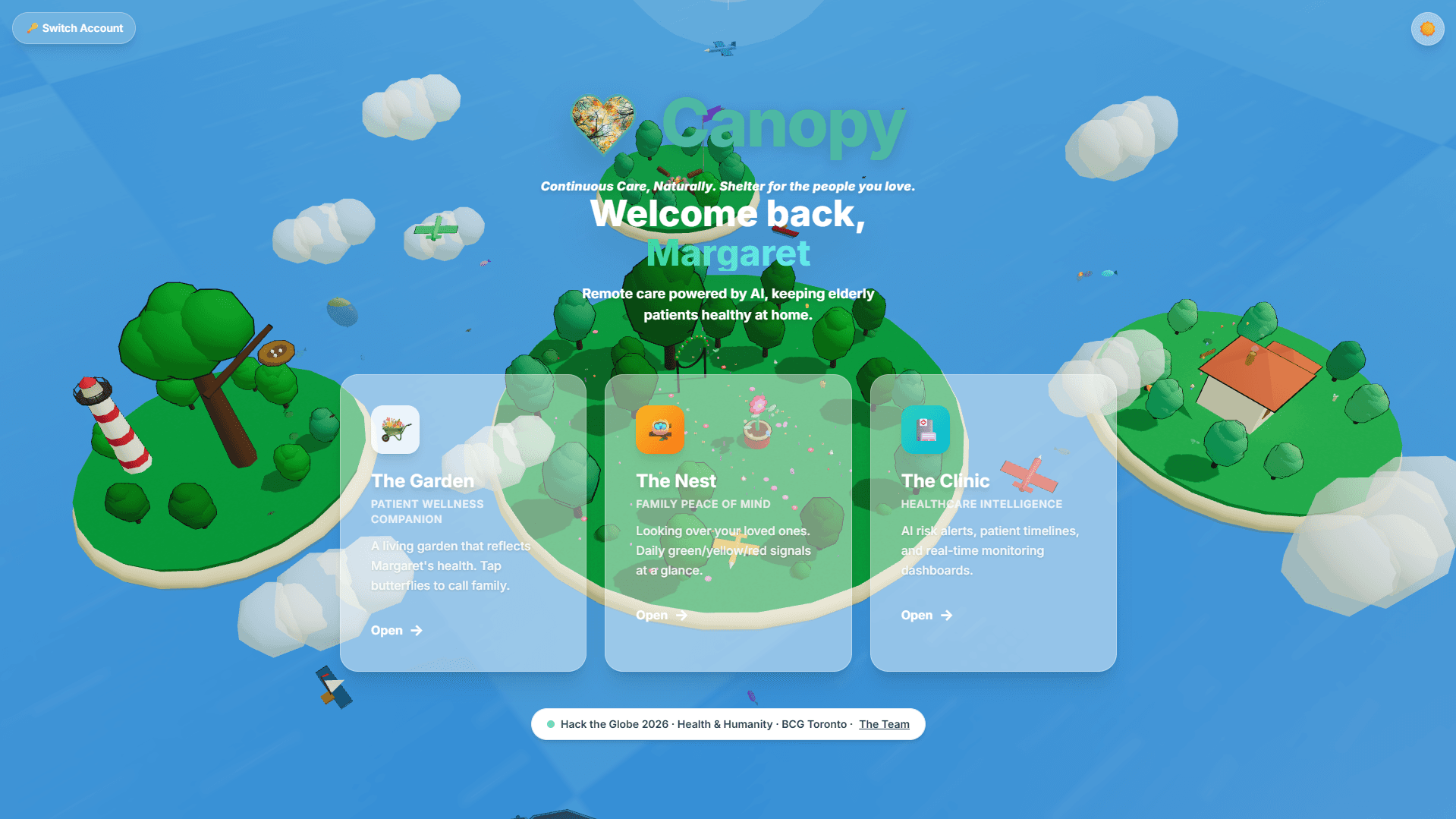
CANOPY
An elderly remote-care platform, a Hack the Globe finalist and top 2 in the Health and Humanity track, built by making AI work for a 75-year-old patient and a clinician at the same time.
The Problem
Elderly patients at home have no structured way to flag deteriorating vitals to caregivers and clinical staff before a crisis. Existing tools either overwhelm non-technical users or lack the clinical depth that care teams need to act on.
My Role
Full-stack and AI engineer, number-one GitHub contributor on a team of four, owning the LangGraph pipeline, the Three.js Garden interface, and the real-time Supabase integration.
The Approach
- Built a four-node LangGraph StateGraph (Ingest, Assess Risk, Communicate, Plan Discharge) on a FastAPI backend: the Ingest node normalizes patient vitals and computes baselines, Assess Risk combines a deterministic rules engine with a Groq/Llama 3.3 70B narrative to produce a 0-100 risk score, Communicate fans out caregiver summaries and clinical alerts, and Plan Discharge emits a structured recovery plan.
- Designed three role-specific Next.js 15 interfaces: a zero-literacy 3D Garden for patients (hand-coded vanilla Three.js with procedural geometry, cel-shaded outlines, animated clouds, birds, swaying plants, and a pulsing lighthouse), a Nest traffic-light dashboard for family caregivers, and a Clinic risk-stratification view for healthcare staff.
- Wired Supabase Realtime so that every vitals submission by the patient propagates live to the caregiver and clinical dashboards without polling.
- Built a 300-plus-response chat fallback system across 80-plus intent categories so the patient interface remained empathetic and functional when the Groq LLM was unavailable.
Key Decisions
- Chose vanilla Three.js over a model-loader approach for the Garden scene because procedural geometry with no GLTF assets meant zero load-time dependency and full control over the cel-shaded, accessible aesthetic required for a zero-literacy patient interface.
- Used a mutable ref bridge between React state and the Three.js animation loop inside a useEffect closure to implement a fly-to camera transition system, decoupling React's render cycle from the imperative animation loop without triggering unnecessary re-renders.
- Invested heavily in the fallback chat layer (300-plus hand-authored responses, 80-plus intent categories) rather than treating the LLM as always-available infrastructure, because a care platform that fails silently for an elderly user is worse than no AI at all.
Impact & Results
- Finalist at Hack the Globe 2026 and top 2 in the Health and Humanity track (BCG Toronto, 232 participants), with judges flagging the triple-interface design as the strongest clinical workflow in the track.
- 117 commits shipped in 36 hours across a team of four, with the platform covering patient check-in, live caregiver alerts, clinical risk stratification, and structured discharge planning end-to-end.
The Stack
Next.js 15TypeScriptThree.jsFramer MotionTailwind CSSFastAPILangGraphGroq / Llama 3.3 70BSupabase RealtimeDocker
What I Learned
- The hardest part of AI is not always the model: in CANOPY the real engineering work was making the interface disappear so a patient with no digital literacy could safely act on the output, which forced every design and technical decision through an accessibility lens.
- A deterministic rules engine paired with an LLM narrative is a better pattern for risk-stratification than an LLM alone, because the rules give auditable, reproducible scores while the LLM adds the plain-language explanation that a caregiver or patient can actually act on.
- Building a robust fallback system before the demo saved us during the live judging session, and reinforced that any AI feature meant for a vulnerable population needs a graceful degradation path that is as thoughtfully engineered as the happy path.